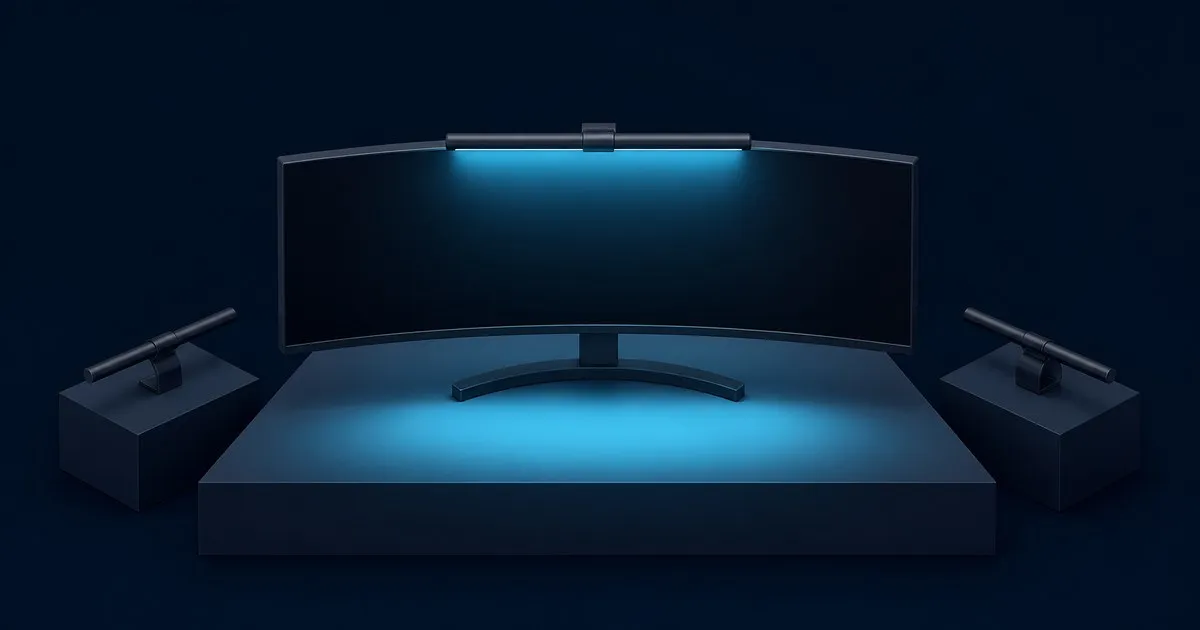
Best Light Bar for Ultrawide Monitor: Specs Compared
The best light bar for an ultrawide monitor depends on bar length, 500-lux coverage, curvature range, monitor thickness, and USB power.
The best light bar for ultrawide monitor setups is not the brightest one. It is the one whose lit band on the desk is at least as wide as the panel above it, whose clamp is rated for your screen’s curve and thickness, and whose power draw your USB port can actually supply. Most bars in the category were sized for a 24 to 27 inch display, and on a 34 inch or 49 inch panel the outer third of the desk ends up in shadow.
The photometrics (lux targets, CRI and R9, glare geometry) are in the monitor light bar buying guide; this post covers only what changes when the panel is wide.
Why a standard bar comes up short on an ultrawide
Panel width is fixed by geometry. A 34 inch 21:9 display is about 31 inches (79 cm) wide edge to edge; a 49 inch 32:9 super-ultrawide is about 47 inches (120 cm). A standard bar in the 40 to 45 cm class, like the Quntis 15.7 inch bar Quntis lists for 21 to 27 inch monitors, is barely half the width of a 34 inch panel and a third of a 49.
Bar length understates the problem slightly because the beam spreads. BenQ is the only manufacturer in this group that publishes a coverage area: its 50 cm bars claim a consistent 500 lux across 85 x 50 cm at a 50 cm mounting height. That 85 cm band is a hair wider than a 34 inch panel, so a 50 cm BenQ bar covers the desk in front of a 34. On a 49 inch panel it covers roughly 70 percent, leaving about 17 cm at each end below 500 lux.
Whether that falloff matters is a uniformity question. The European office lighting standard EN 12464-1 requires the immediate surrounding area of a task to hold a minimum-to-average illuminance ratio of at least 0.4. If the desk centre reads 500 lux and the wings read 150, you are below what an office designer would sign off. OSHA’s computer workstation guidance frames the same target from the other direction: 20 to 50 foot-candles for office work, up to 73 for LCD monitors, with task lighting positioned so it does not reflect on the screen.
The numbers that decide it
| Model | Bar length | Published 500 lux coverage | Curvature range | Monitor thickness | Power |
|---|---|---|---|---|---|
| BenQ ScreenBar Halo 2 | 50 cm (19.7 in) | 85 x 50 cm at 50 cm height | 1000R to 1800R | 0.43 to 6 cm | 5 V / 3 A, max 15 W |
| BenQ ScreenBar Pro | 50 cm (19.7 in) | 85 x 50 cm at 50 cm height | 1000R to 1800R | 0.43 to 6.5 cm | 5 V / 1.7 A, max 8.5 W |
| Quntis Curved Monitor Light Bar IM | 65.4 cm (25.74 in) extended, hinged | Not published (“1000 to 500 lux”, no distance) | 1000R / 1800R stated | Not published | 5 V / 2 A adapter supplied |
| Quntis Light Bar PRO+ | 51 cm (20.1 in) | Not published | Curved or flat | 0.3 to 6 cm (0.12 to 2.36 in) | Not published |
| BenQ ScreenBar Max | 85 cm fixture, desk clamp | 135 x 58 cm at 71 cm height | Not monitor-mounted | Desk up to 6 cm | Mains, max 36 W |
All figures are from the manufacturer pages under Sources; the Quntis adapter rating is from the Armchair Arcade review.
The gaps are the story. Quntis sells the longest monitor-clamp bar here and publishes no coverage area, no height for its lux claim and no thickness range for the IM; BenQ publishes all three and charges for it. BenQ states Ra of at least 95 and Rf of at least 96 on both 50 cm bars; Quntis claims “ultra-98Ra” on the IM with no R9 or Rf figure, so the number cannot be compared.
Picks by panel size
34 to 38 inch 21:9, curved or flat. A 50 cm BenQ bar covers the desk in front of the panel with a published 85 cm band. The ScreenBar Pro draws 8.5 W, fits slightly thicker panels (6.5 cm) and adds an ultrasonic sensor: on with movement within about 60 cm of the screen, off after 5 minutes without it. The Halo 2 spends more power (15 W) and money on a tri-zone backlight and a rechargeable wireless controller rated at up to 3 months per charge. Buy the Halo 2 for the backlight; otherwise the Pro is the better buy. The value alternative is the Quntis PRO+ at 51 cm, $69.99 on the Quntis store at the time of writing: same length, no published coverage figure.
49 inch 32:9. No monitor-clamp bar reaches 120 cm. The closest is the Quntis IM: two hinged heads extending to 65.4 cm, listed at $66.99 and aimed at 34 inch plus 1000R and 1800R screens. See the fit caveat below. The fixture that actually covers the width is the ScreenBar Max, a desk-clamp dual-monitor lamp launched in August 2026. Because it clamps to the desk, curvature and bezel thickness stop mattering; it publishes 500 lux across 135 x 58 cm with 1400 lux at the centre from 71 cm, wider than a 49 inch panel. It runs from mains at up to 36 W, and Engadget reports $289 plus $39 for the optional stand, roughly four times a Quntis.
Fit checks before ordering
Curvature. A straight bar on a curved top bezel contacts at the middle and its ends stand off the screen line. On a 1000R panel a 50 cm straight bar’s ends sit about 3.2 cm proud of the bezel; on 1800R about 1.8 cm. The hinged Quntis IM avoids that, but introduces its own problem: the Armchair Arcade review tried it on an INNOCN 49Q1R, a 49 inch 1800R panel inside the stated range, and reported it “just didn’t fit right, thanks in part to the thickness of the monitor’s depth and how the two wings of the light curve.” A stated R range is a necessary condition, not a guarantee.
Thickness. Measure the top edge of your panel including any rear bulge the clamp will sit on. BenQ’s ranges are 0.43 to 6 cm (Halo 2) and 0.43 to 6.5 cm (Pro). Quntis publishes 0.12 to 2.36 inches for the PRO+ and nothing for the IM.
Power. The Halo 2 needs 5 V at 3 A, more than a monitor’s USB hub typically supplies, so plan on the included adapter or a USB-C port rated for 3 A. The Pro’s 1.7 A is easier to find. Underpowered bars flicker or drop brightness, covered in monitor light bar problems.
Bezel clearance. A centre-mounted webcam or a non-flat top surface will fight any clamp; only BenQ claims its Pro clamp handles “monitors with special back designs or non-flat top bezel”.
What a light bar will not fix on an ultrawide
A bar lights the desk, not the wall behind the panel. If the complaint is a bright screen in a dark room rather than a dark desk, the fix is bias lighting; the trade-offs are in bias lighting vs monitor light bar. A bar also cannot correct screen height, and a 49 inch panel on its stock stand often sits above the top-of-screen-at-eye-level rule. The ultrawide monitor arm guide covers the weight and VESA numbers that decide which arm holds one; monitor placement for long sessions is the companion read.
The desk lux calculator turns task and panel width into a target illuminance and bar length; if a manufacturer will not publish coverage at a stated height, assume the wings of your desk are on their own.
Related across the network
- Best Desk Mat for Large Monitors: Size It to the Stand, Not the Screen — deskmatreviews.com
- Best Filament for Beginners: What to Buy First — 3dfilamentguide.com
- Bambu A1 vs A1 Mini: Which Bed-Slinger Wins? — bambureviews.com
- Bambu Bed Sizes, Build Volumes and Desk Footprints — bambureviews.com
- Bambu P1P vs P1S: Is the Enclosure Worth It? — bambureviews.com
Sources
- ScreenBar Halo 2 specification (BenQ US)
- ScreenBar Pro ultrawide monitor light bar (BenQ US)
- ScreenBar Max specification (BenQ US)
- BenQ's first dual-monitor desk lamp will give your screens a glow up (Engadget)
- Quntis Curved Monitor Light Bar IM 66 cm (26 inch)
- Monitor light bar collection (Quntis)
- The Light Bar For Any Monitor: Quntis Light Bar PRO+
- Quntis Monitor Light Bar for Curved Displays review: A bright idea, but mind the fit (Armchair Arcade)
- Ratio of illuminance and uniformity requirements, EN 12464-1 (Fagerhult)
- Computer Workstations eTool: Workstation Environment (OSHA)
Related

Monitor Light Bar Buying Guide: Specs That Matter
A monitor light bar buying guide built on specs: desk lux targets, CRI with a published R9, bar length, USB power budget, and bezel fit checks.

Best Desk Lamp for Computer Work: 6 Models Compared
The best desk lamp for computer work delivers 300-500 lux without screen glare; six models are compared by lux, CRI, CCT, flicker, and warranty.

Desk Lamp vs Monitor Light Bar: Specs and Use Cases
This comparison covers illuminance, coverage, power, mounting, and glare control to show when each fixture suits screen-centered or paper-heavy desks.