Bias Lighting Behind TV vs Monitor: Key Differences
Bias lighting behind TV vs monitor uses a D65 white point, but viewing distance, room light, strip length, wall clearance, and reactive sync differ.
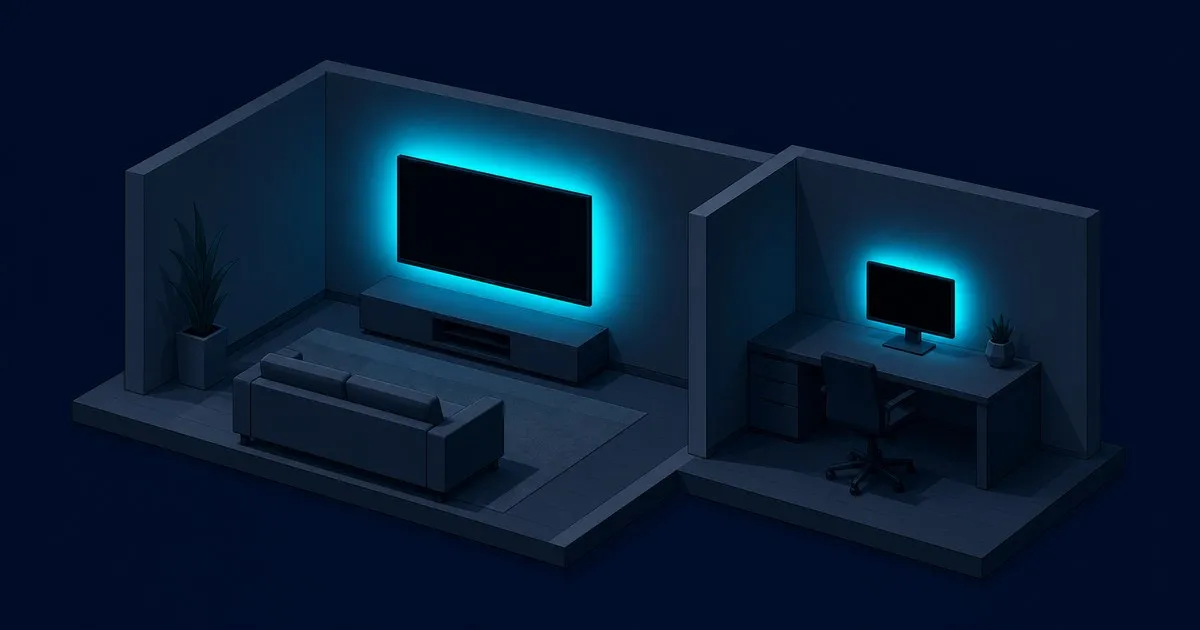
The bias lighting behind TV vs monitor question has a short answer and a long one. Short: the target is identical, a dim neutral-white wash at about a tenth of the screen’s peak white, from the same broadcast documents whichever display you own. Long: everything around that target differs. A TV sits eight feet away in a dark room showing video; a monitor sits two feet away in a lit office showing a white document. A strip sold for one is routinely the wrong length, brightness and, if reactive, the wrong product for the other.
| Behind a TV | Behind a monitor | |
|---|---|---|
| Surround target | About 10 percent of SDR peak white; 5 cd/m² for HDR | Same ratio, scaled to your brightness setting |
| Colour | D65, sold as 6500 K | D65, sold as 6500 K |
| Room light in use | Dim to dark | Lit by day, so the strip matters at night |
| Viewing distance | 1.6 to 3.2 picture heights | 20 to 40 inches |
| Strip length | 3 to 7 m, four sides | 1 to 2 m |
| Reactive option | HDMI sync box or clip-on camera | Desktop software capture |
| Common failure | Bright colour wall behind a film | Arm plate in the way, or two strips overlapping |
The standard is shared, the room is not
Both targets come from ITU recommendations written for grading suites. ITU-R BT.2035 sets the background at D65, the ratio of background luminance to peak picture luminance at approximately 10 percent plus or minus 2 percent of reference white, room illumination at 10 lux and reference white at 100 cd/m², so the wall behind an SDR display should sit at 8 to 12 cd/m². For HDR, ITU-R BT.2100-3 (February 2025) fixes the surround at 5 cd/m², neutral grey at D65, and does not scale it with the display’s peak, which it specifies for small highlights rather than full-screen white. A 1,000-nit TV does not earn a 100-nit wall.
A living room with the lamps off approximates that environment. An office does not: OSHA’s workstation environment guidance puts office lighting at 20 to 50 foot-candles for paper tasks and up to 73 for LCD work, so by day the room, not the strip, sets the surround. OSHA’s warning is the one the ITU documents manage: high contrast between screen, work surface and surroundings causes eye fatigue and headaches. Behind a monitor, bias lighting is an evening tool. Behind a TV it is the whole environment.
Distance and angle: closer than you think, on both
BT.2100 gives a viewing distance of 3.2 picture heights for 1080p and 1.6 to 3.2 for 3840 by 2160. A 65-inch 16:9 panel is about 32 inches tall, so that is roughly 4.3 to 8.5 feet. OSHA’s monitor guidance puts a computer screen at 20 to 40 inches with the top at or slightly below eye level; a 27-inch monitor is about 13 inches tall, so that is 1.5 to 3 picture heights. Both fill about the same angle of view, which is why the 10 percent ratio transfers and the wall on every side sits in peripheral vision. Getting a monitor to that height is covered on Monitor Arm Guide; Home Desk Guide covers placement for long sessions.
What differs is the gap to the wall. A flush wall-mounted TV leaves the strip an inch or two from plaster and throws hot spots unless the LEDs are inset well inside the panel edge. A monitor on an arm can sit anywhere from touching the wall to a foot off it, sharing that wall with a lamp, cables and often a second display.
What the eye-strain evidence actually says
The marketing claim is that a bias light reduces eye strain. The literature is thinner than the product pages suggest. Wolska and Switula (1999) varied only the luminance of the wall behind the display across three conditions, on CRT and LCD screens, and recorded reported symptoms alongside objective visual functions. Surround luminance had no significant effect on reported symptoms for either screen, and the objective trend ran the other way: changes in visual function grew as the surround got brighter, with a statistically significant drop in accommodation amplitude. Bullough, Akashi, Fay and Figueiro (2006) tested the TV case: nine viewers aged 32 to 52 watched a 60-minute programme with and without surrounding illumination, which “appeared to provide a small improvement in several” of the measures taken.
So a dim surround helps a little at best, and a bright one measurably loads the focusing system, which argues for the spec’s low target on both displays and against the feature-wall brightness most strips ship at. It is a comfort adjustment, not a treatment: persistent eye strain, headaches or blurred vision belong with an optometrist or clinician, not a light strip.
Behind a TV: static D65 or reactive colour, pick one job
Static D65 strips do what the ITU documents describe. The MediaLight Mk2 v2 Flex is the reference example: 6500 K, CRI of 98 or higher, 5 V USB power drawing up to 900 mA at full output, lengths from 1 to 7 m with the 7 m run rated for displays up to 105 inches on four sides, a five-year limited warranty, and $72.94 for 1 m. The premium over a generic RGB strip buys a controlled white point and a fidelity figure.
Reactive kits are a different product. The Govee Envisual T2 clips a dual camera to the top bezel and drives an RGBIC strip to match the picture, in 55 to 65 inch and 75 to 85 inch kits, listed at $69.99 at the time of writing against a $139.99 list price. The Philips Hue Play HDMI Sync Box 8K reads the signal instead: four HDMI 2.1 inputs, Dolby Vision and HDR10+, up to 10 Hue lights, a required Hue Bridge, and $384.99 before the lights.
By the standard’s definition, reactive lighting is not bias lighting. A D65 surround works because it does not change; a wall that swings colour and brightness with every cut is the effect the reference environment removes. That makes it an entertainment purchase, not a bad one. Most reactive kits have a static white mode, but whether that white is a controlled 6500 K is rarely on the spec sheet.
Behind a monitor: short strip, software sync, and the arm problem
Length changes first: a 24 to 34 inch panel needs 1 to 2 m of strip, and a TV kit’s four pre-cut segments are sized for a TV.
The reactive option changes too, because the computer already knows what is on screen. Philips Hue’s desktop sync app for Windows and macOS analyses screen content and drives colour-capable Hue lights through a Bridge and an entertainment area, with intensity from Subtle to Intense. Fine for games; for text work, a surround that flickers with every scrolled window defeats the steady adaptation you set the strip up for, so leave it in static white during work hours.
Three installation problems that never come up on a TV:
- The VESA plate. An arm’s mount sits dead centre on the back panel, where a four-side strip wants to pass. Route around it, or run three sides and accept a dimmer bottom edge.
- Two monitors, two strips. Where they meet behind the inner bezels the wall gets both and the centre of your view becomes the brightest patch. Run one strip behind both panels, or dim the inner segments.
- Curved panels. The strip must follow the curve or the wash goes uneven. Flexible strips do; rigid bars do not.
Power is easier at the desk: most monitor USB hubs power up with the host, so a USB strip switches with the PC, and a short run is well inside what any port supplies. On a TV, check the port’s rating before hanging a 7 m run off it.
Brightness follows the same ratio, with one adjustment: a monitor showing documents is full white over most of the panel and often set brighter than a film, so the wall target rises with it. The check is the same either way: with a mid-grey image on screen, the wall should be clearly dimmer than that grey.
Which to buy, one line each
- TV, films, dark room: a static 6500 K strip on four sides, dimmed to a tenth of screen white.
- TV, games and HDR spectacle: a reactive kit, bought as an effect, switched to white mode for films.
- Monitor, evening work: a 1 to 2 m static strip off the monitor’s USB hub.
- Monitor, gaming: a software-synced strip, static white during work hours.
- Either: not the other’s kit. A 55-inch camera kit behind a 27-inch monitor is a coil of surplus LEDs and a camera with nothing to look at.
Inset distance, wall colour, CRI and the order to add bias light against a light bar are in bias lighting vs monitor light bar. Run the mirror test in how to reduce screen glare at a desk first; a strip behind the display does nothing about a lamp reflected in it.
Sources
- Recommendation ITU-R BT.2035: A reference viewing environment for evaluation of HDTV program material
- Recommendation ITU-R BT.2100-3: Image parameter values for high dynamic range television
- Computer Workstations eTool: Monitors (OSHA)
- Computer Workstations eTool: Workstation Environment (OSHA)
- Wolska and Switula, Luminance of the surround and visual fatigue of VDT operators (Int J Occup Saf Ergon, 1999)
- Bullough et al., Impact of Surrounding Illumination on Visual Fatigue and Eyestrain While Viewing Television (J Appl Sci, 2006)
- MediaLight Mk2 v2 Flex 6500K CRI 98 bias lighting (manufacturer page)
- Govee Envisual TV Backlight T2 (manufacturer page)
- Philips Hue Play HDMI Sync Box 8K (manufacturer page)
- Sync lights to your PC (Philips Hue)
Related

Bias Lighting vs Monitor Light Bar: What Each Fixes
Bias lighting vs monitor light bar: one raises surround luminance behind the screen, the other lights the desk. What each fixes, and the order to add them.

Best Color Temperature for Desk Lighting by Time of Day
The best color temperature for desk lighting is 3500-5000 K by day and 2700 K before bed, with 500 lux as the key daytime target.

Monitor Light Bar Buying Guide: Specs That Matter
A monitor light bar buying guide built on specs: desk lux targets, CRI with a published R9, bar length, USB power budget, and bezel fit checks.